


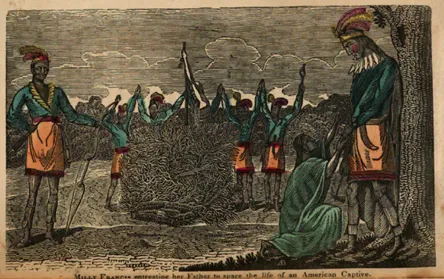
Milly Francis became known to Americans in 1818 as the Creek Pocahontas, credited with saving a white militiaman from death at the hands of her father, a Red Stick Creek leader resisting US advancement into Muscogee territory. This narrative left her doubly concealed from the historical record, first when the penny press flattened her story to fit a newssheet, then when historians dismissed her as a romanticized heroine unfit for scholarly inquiry. Yet, her story is both compelling and illuminating. She survived US wars against her people only to be forced down the Trail of Tears even as her husband died fighting for the US in the Creek Volunteer Regiment, arriving in Indian Territory a widow. She was a slaveholder who fought the Seminoles for the return of African-descended people she claimed to own, a prominent member of a Native family who resisted American sovereignty in modern-day Alabama and Florida, and a mother who died in poverty while hoping that American promises might ensures her children’s survival. Moreover, her life reveals how the US Army developed from the nascent frontier organization of her youth into a powerful institution. Early in her life, Andrew Jackson, then a militia general, summarily executed her father in Florida, prompting national debates and exemplifying the contentious, semi-organized state of the American military. By 1842, regular army officer Ethan Allen Hitchcock used well-established bureaucratic processes to convince Congress to grant Francis a pension and a gold medal, the first woman so honored. Her life shows the development, and human cost, of military paternalism.
Speaker
Justine Meberg is the author of Protecting Women, published by Cambridge University Press and winner of the Bancroft Dissertation Award from Columbia University and the SHEAR Broussard Best First Book Prize. Her work on the Second US-Seminole War and the US-Mexican War recovers the rarely heard voices of immigrant soldiers, Indigenous women, and Mexican women alongside officers' narratives to tell the stories of women’s wartime activities. She received her PhD from Columbia, where she was advised by Stephanie McCurry.
Coffee will be served at 3:30pm. The event will start at 3:45pm.
About the International History Seminar
If you are interested in attending this semester’s events and joining the International History Seminar, please send an email confirming your interest to the Hayes Chair Graduate Research Associate at hayeschairgra@osu.edu, and you will be included on the mailing list going forward. Materials will only be pre-circulated to people on the mailing list.
