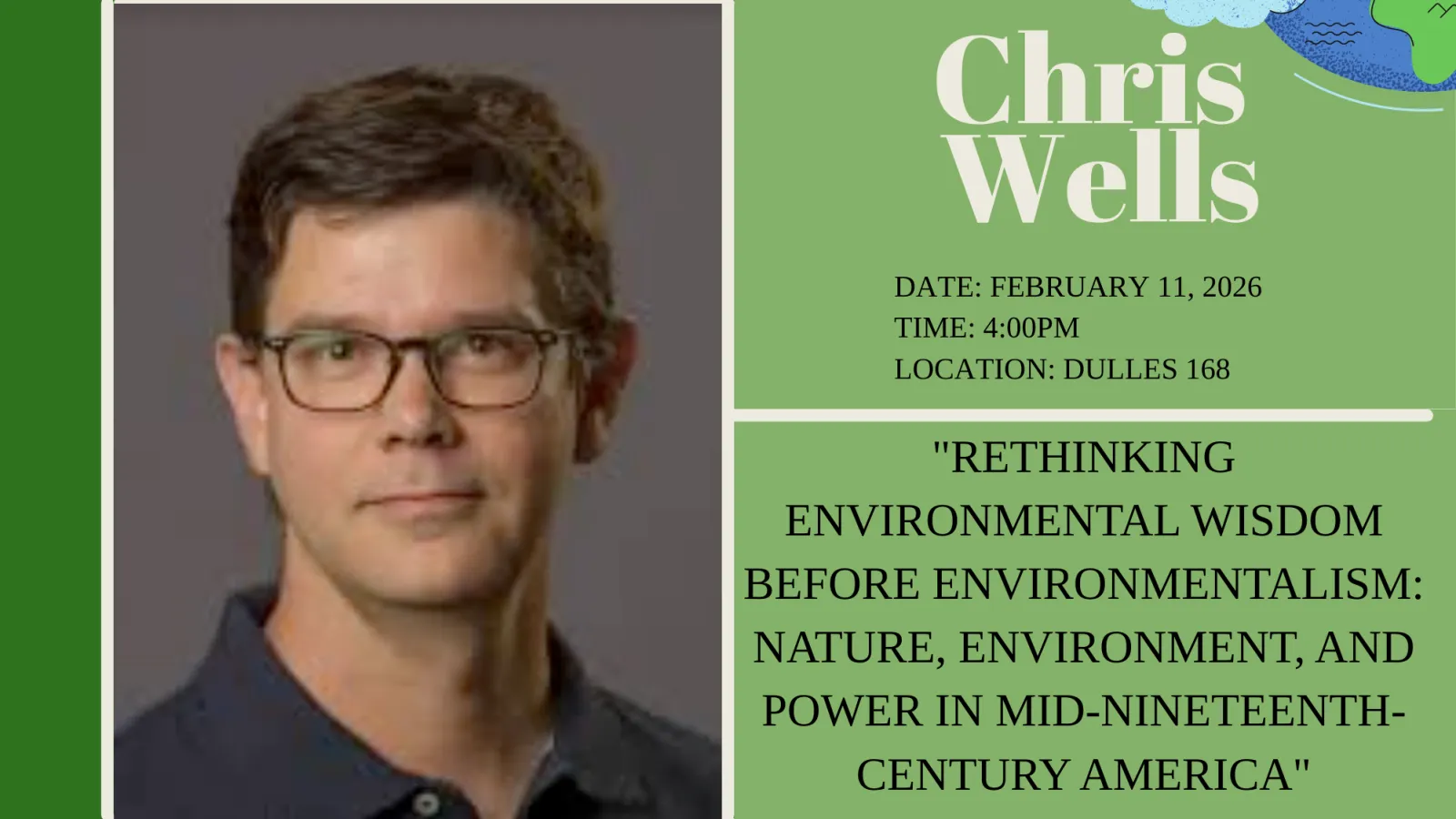
"Rethinking Environmental Wisdom before Environmentalism: Nature, Environment, and Power in Mid-Nineteenth-Century America"
Abstract: Environmental thought in the United States is often narrated as a progressive story, beginning with Transcendental reverence for nature and only gradually expanding—especially in the more recent past—to include concerns about power, inequality, and justice. This talk challenges that timeline. By situating Walden in the political and environmental upheavals of the 1840s and 1850s—the Impending Crisis of slavery, two decades of Indian Removal, aggressive western expansion, and the California Gold Rush—I argue that questions of power, constraint, and dispossession were already central to American environmental thought. Reading Henry David Thoreau alongside contemporaries who have not typically been read as “environmental” writers reveals a shared preoccupation with how land, labor, risk, and possibility were being reorganized in real time. When Susan Fenimore Cooper found moral instruction in settled rural landscapes, Frederick Douglass used forests to explain the violence and political economy of slavery, and John Rollin Ridge wrote about homelands fractured by dispossession, they were not turning away from nature but grappling with environments already remade by domination and expansion. We have missed these authors as environmental thinkers not because they ignored nature, but because we have too often looked for nature rather than for the environmental conditions through which power was exercised and contested.
Christopher W. Wells is professor and chair of Environmental Studies at Macalester College. He is an environmental historian whose research focuses on the ways that technological and socioeconomic systems have reshaped the American environment, mediating and structuring people’s relationships with the natural world. His newest book is Nature’s Crossroads: The Twin Cities and Greater Minnesota (2022), co-edited with George Vrtis. His first book, Car Country: An Environmental History (2012), focuses on the proliferation of car-dependent landscapes in the U.S. before 1956. His second book, Environmental Justice in Postwar America: A Documentary Reader (2018), documents the rise and evolution of the environmental justice movement, as well as its frequently uneasy relationship with the mainstream environmental movement. His newest project, Rethinking Environmental Wisdom, revisits classic environmental texts to show how debates about land, work, and power have always been part of the American environmental story.