
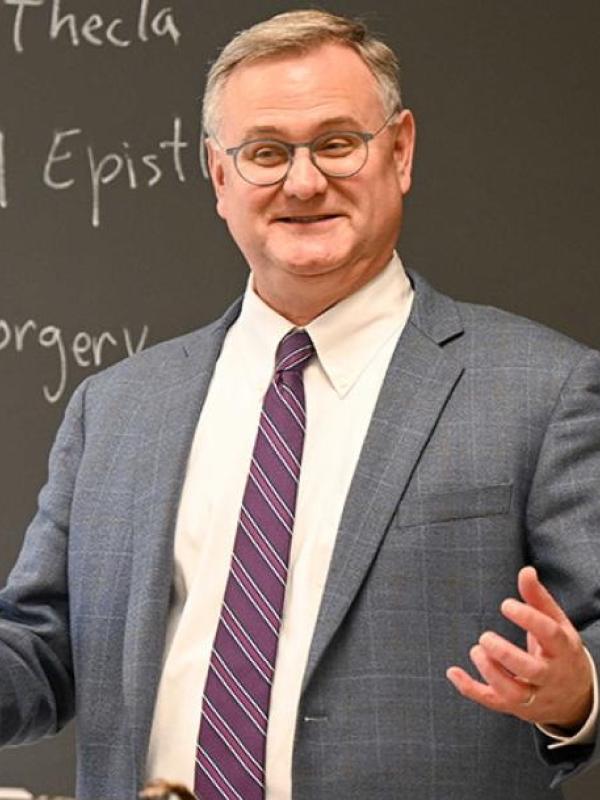
J. Albert Harrill
Professor and Director of Graduate Studies
he, his, him
238 Dulles Hall
230 Annie and John Glenn Avenue
Columbus, OH
43210
Office Hours
Weds 9:00–10:00 a.m., and 2:30–3:30 p.m. in Dulles 238 (Autumn 2024)
Areas of Expertise
- Ancient History
- Religion in History
Bert Harrill is a specialist of the social and cultural history of early Christianity and other ancient Mediterranean religions. His research interests focus on the New Testament writings in their Greco-Roman environment.
Professor Harrill has authored three books. Paul the Apostle: His Life and Legacy in Their Roman Context (Cambridge University Press, 2012) challenges contemporary notions of Paul in traditional biographies, by focusing on Paul’s discourse of authority as both representative of its Roman context and provocative to his rivals within early Christianity. It also explores the legends that developed around Paul as later interpreters remade the figure into a model citizen, an imperial hero, a sexual role model, and an object of derision. Slaves in the New Testament: Literary, Social, and Moral Dimensions (Fortress Press, 2006) examines how Roman slavery shaped the thinking of early Christians, with significant new analysis of the Pauline epistles, the parables of Jesus, late ancient martyrdom accounts, and the modern debates over slavery in the antebellum U.S. South. The Manumission of Slaves in Early Christianity (Mohr Siebeck, 1995) identifies the pitfalls of moral anachronism that have beset so much investigation of slavery in early Christianity, by focusing on the first known pieces of Christian literature that address the liberation of slaves in order to understand how churches functioned socially within the Roman Empire. His research has been supported by grants from the Alexander von Humboldt Foundation (Germany) and the National Endowment for the Humanities.
He teaches a broad range of courses in ancient history and premodern Christianity. These include New Testament introduction, the apostle Paul and his influence in early Christianity, the historical Jesus and the gospel traditions, slavery in the ancient world, forgery in early Christian literary culture, and dream interpretation in antiquity.
Before joining OSU, he taught for a decade as a professor of religious studies at Indiana University, Bloomington (2002–12). Additionally, he has held invited guest professorships at the University of Chicago Divinity School (Spring 2012) and Williams College in Massachusetts (Fall 2015). Trained as a biblical scholar, he received the Ph.D. and M.A. in New Testament and early Christian literature from the University of Chicago, and B.A. (highest honors) in religious studies from the University of North Carolina at Chapel Hill.
• 2021 Sphinx and Mortar Board Outstanding Faculty
• 2019 Honors Faculty Service Award in the Arts and Sciences
• 2017 Clio Award, Distinguished Faculty Teaching in History