
Scott Levi's End of Term Donor Letter
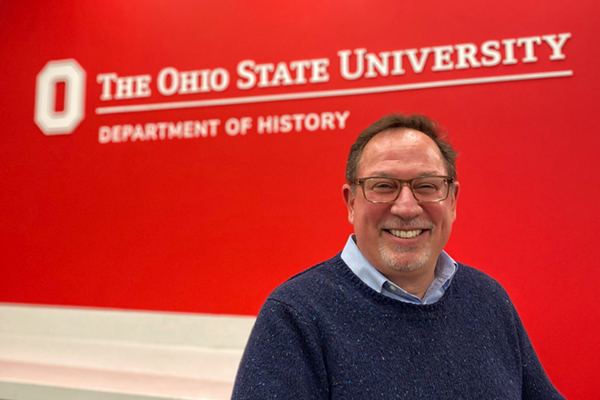
It has been a great honor to serve as chair of the Department of History these past eight years. As my second term comes to an end this summer, I look forward to returning to my research, designing and teaching new courses, and exploring other ways to serve the department and contribute to the Ohio State community.
These past eight years, the department has faced significant challenges. Of course, none of these were more disruptive than Covid, which required us to shift all instruction and university business online and quickly master new pedagogical tools and strategies. That unfolded alongside the imposition of a new General Education curriculum that eliminated history education requirements, national conversations that called into question the value of higher education, a wave of new budgetary challenges, a series of sudden changes at the level of senior leadership, and so much more.
Throughout it all, the faculty, staff, and students in the Department of History have time and again impressed me with their resilience, their innovative spirit, their unwavering commitments to our discipline and our students, and their deep passion for the critical role that history education plays in civic education and civil society. Like my predecessors, I take great pride in the fact that the Department of History has more winners of the Alumni Award for Distinguished Teaching – the highest teaching honor at OSU – than any other unit on campus. Each year, only ten of these are awarded among the roughly 3500 faculty on campus. This year, history faculty again won two.
Other department chairs ask me how we do it. As Woody Hayes said: “You win with people,” and we support our people. This has enabled us to build and maintain a healthy and vibrant departmental community that extends beyond the bounds of Dulles Hall and the Columbus campus to our regional campuses in Lima, Marion, Mansfield, and Newark. It ensures that we never lose sight of our commitments to historical research, teaching, and serving the citizens of Ohio. Providing our students with excellent instruction also ensures that our enrollments remain robust, which enables us to serve the state by teaching large numbers of students how to think historically, how to conduct original research, how to analyze primary sources for bias and reliability, how to craft and support an argument, and how to present their thoughts clearly and in a professional manner. We take great pride in preparing our students to launch successful careers and thrive wherever those careers may take them.
Our efforts have brought results. Last spring, we underwent an extensive academic program review. Three external reviewers, all senior leaders selected from “aspirational benchmark” institutions, lauded our success at overcoming the many challenges we faced. They recognized our position as national leaders in military history and environmental history, and they singled out our success at building an extraordinary public history program with an outreach and engagement arm “that could serve as a model for all land-grant universities.” Additionally, we have revised our graduate program to create opportunities for students to earn a stand-alone M.A. degree, including a B.A./M.A. option for our undergraduate majors. And our undergraduate major remains strong, with some 350 majors and another 500 minors, far above nearly every other history department in the country. Every year we teach more than 10,000 students on the Columbus campus alone. This places us at the top of the Big Ten — and is more than twice as many students than our history colleagues teach at that School up North.
Our colleagues have also remained extraordinarily productive. Over the past eight years, we have published more than 50 books (!) and we continue to earn recognition and win awards at the college, university, national, and international levels. We have six Guggenheim fellows, eight NEH fellows, six ACLS fellows, three Fulbright fellows, three American Philosophical Society fellows and two Humboldt fellows. During this same period, six of our colleagues have been selected as Arts and Sciences Distinguished Professors and one was named a University Distinguished Professor (former chair Peter Hahn). With considerable gratitude to our alumni and friends, since 2018, we have increased the number of endowed professorships and chairs in the department from seven to twelve, and we have increased our endowment holdings by more than $9.5 million. These achievements have greatly improved our ability to serve our students, and they have also had a positive effect on our national reputation. This past year, we rose from number fifteen to number nine in the U.S. News & World Report ranking of public university history programs.
Recent developments will help to ensure that our sustained efforts and progress will continue long after my term ends on July 1. I am delighted to report that Professor Nicholas Breyfogle has been selected to serve as the next department chair. Nick is a specialist in Russian imperial and environmental history, a good friend, and a great colleague. As he steps into the role of department chair, I look forward to supporting him as he works to face new challenges and build new areas of distinction.
Serving the department these past eight years has been a highlight of my professional career. I have deeply valued the opportunity to support my colleagues and to work with dedicated alumni and friends of the department such as yourself. Again, thank you very much for your time, your engagement, and your support.
Go Bucks!

Dr. Scott Levi
Professor and Chair